



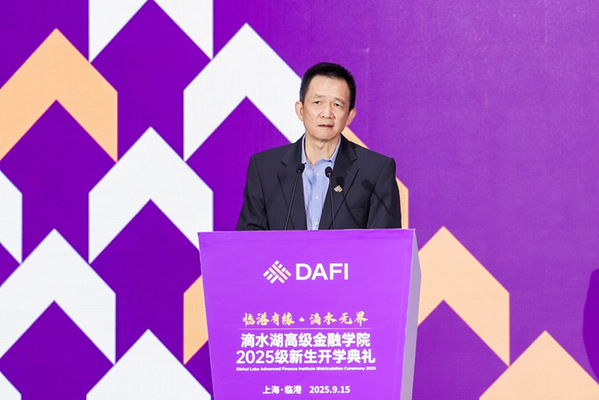
Under the background of in-depth global economic adjustment and the financial industry entering a “correction period”, how should China view its development path and the future of finance? At Dishui Lake Advanced Finance Institute, Shanghai University of Finance and Economics (SUFE-DAFI) Matriculation Ceremony 2025, Professor YAO Yang, Dean of DAFI, delivered an open class to answer this question of the times.
In his speech, Dean YAO Yang emphasized that “finance was not a sunset industry, but the cornerstone of the modern economy”, and pointed out that although innovation could not be planned, the capital market must assume the incentive management responsibility and the backstop responsibility. In Lingang Special Area, a forefront of the reform and opening-up, finance not only was related to institutional innovation, but also could provide cutting-edge support for Chinese enterprises going global and for the national strategies.
Although the reform and opening-up had led to the economic take-off,
correction cost must be paid for the accumulated problems.
On the open class, Dean YAO Yang first pointed out that to understand the value of finance, we must understand the ages China used to live and lives in now. During the planned economy period, China facilitated the industrial accumulation based on strong collectivism, thus laying the foundation for subsequent economic development.Since the launch of the reform and opening-up policy in 1978, the enthusiasm of individuals had been fully unleashed. Combined with the industrial foundation laid prior to this period, this unleashed enthusiasm had fueled China's economic boom over the past four decades. Nevertheless, behind such remarkable achievement, a host of problems had been accumulating: corruption, collusion between officials and businessmen, the excessive marketization of education and finance, and even risks arising from the expansion of the financial system. Precisely because of these issues, China had embarked on a comprehensive rectification across the political, economic, and social areas since 2018. While this process had brought about short-term hardships, it was an indispensable path to avert "financial hollowing-out". He emphasized that China's economic adjustments were now drawing to a close, particularly with the gradual conclusion of the rectification in the financial sector, making the future economic outlook all the more promising.
Finance was not a sunset industry.
The only criterion was whether it could serve the real economy.
In response to the “financial shame” spread in the society, Dean YAO Yang clearly responded that finance had never been a sunset industry but the core foundation of the modern economy, and the problem did not lie in the demand on finance but in how to prevent “excessive financialization”. He took the US as an example, explaining that the US’s multiple setbacks in re-industrialization were rooted in the excessive erosion that finance had brought to the manufacturing industry; while for China, finance must play its role within the boundaries, i.e. finance shall effectively allocate resources and serve the real economy. Dean YAO Yang especially emphasized the differences between China’s systems and the US’s systems: the former was dominated by banks, while the latter was dominated by the capital market. In order to achieve innovation-driven development, China needed to build a more developed capital market in the future, so as to make banks and the capital market complement each other and jointly bring vitality to the economy.
When talking about financial innovation, Dean YAO Yang took the rapid rise and collapse of the peer-to-peer lending (P2P lending) platforms during the period from 2012 and 2018 as an example, and pointed out outright that P2P lending was an “innovation violating basic financial laws”. P2P lending seemed efficient, but it was lack of professional risk screening, ultimately leading to large-scale loss of money. He reminded students that any financial innovation must be closely linked to the real economy; otherwise, it would be destined to be a flash in the pan. He stated that what was truly worth exploring were tools with institutional and strategic value, such as stablecoin, which had practical significance in cross-border payment and dealing with financial hegemony. He emphasized that the only criterion for evaluating financial innovation was whether it could create real value and serve the real economy.
Although innovation could not be planned,
the capital market must assume the incentive management responsibility and the backstop responsibility.
Dean YAO Yang further pointed out that innovation itself could not be planned, and real breakthroughs often occurred in unexpected fields. Cases such as Pop Mart, MIXUE Ice Cream & Tea, AI models, and ultra-high-speed missiles all came from the joint action of “chance and market”; therefore, the capital market shall not only be used for fund-raising but also shall cover innovation failures’ cost by rewarding innovation winners, thereby maintaining the circulation of the innovation ecosystem. China experienced a peak in the venture capital (VC) industry during the period from 2012 and 2018, with the number of its unicorn companies exceeding half of that of the US. However, capital had declined since 2018, especially, the excessive reliance on government investment had resulted in a lack of innovation.
Dean YAO Yang stated outright that China should rebuild the market-oriented capital circulation mechanism in the future, and facilitate the flow of capital from banks to the capital market, so as to revitalize the VC industry.
In this context, the strategic position of Lingang Special Area became prominent. As a forefront of the reform and opening-up and an important hub for offshore finance, Lingang Special Area not only undertook the cross-border payment and fund procurement brought by Chinese enterprises’ demand on going global, but also provided unique scenarios for new financial research and talent cultivation. Dean YAO Yang stated that choosing finance, choosing Shanghai, and choosing DAFI were undoubtedly the correct path towards the future.
At the end of the open class, Dean YAO Yang emphasized firmly: “Finance remained a sunrise industry.” He considered finance as the lifeblood of innovation, supporting point of the national strategies, and the key for students to understand the world and adapt to the future. He hoped that the newly-enrolled students could grasp the general trend, adhere to values, and be bold in making innovation, so as to achieve academic success and accomplish the mission bestowed by the times.