


The paper “Government Deleveraging and the Reverse Crowding-in Effect: Evidence from Subnational Debt and Government Contractors” (the “Paper”), co-authoredby Professor YAO Yang and his collaborators, has recently been officially accepted by Management Science, a top-tier journal in the field of management. Taking China’s 2017 deleveraging policy as a natural experiment, this research systematically examined the transmission mechanism of subnational government debt risk prevention to the corporate sector. It uncovered the “reverse crowding-in” mechanism through which government deleveraging affected the real economy (especially private enterprises) via the trade credit channel, providing a new theoretical perspective and empirical evidence for understanding the complexity of debt resolution policies.
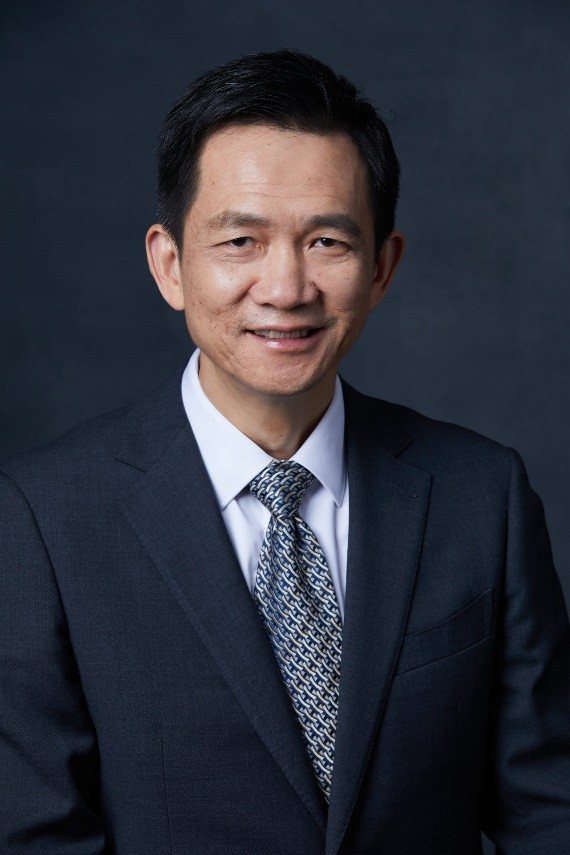
About YAO Yang
Dean and Professor of Dishui Lake Advanced Finance Institute, Shanghai University of Finance and Economics (SUFE-DAFI), Visiting Professor of Peking University
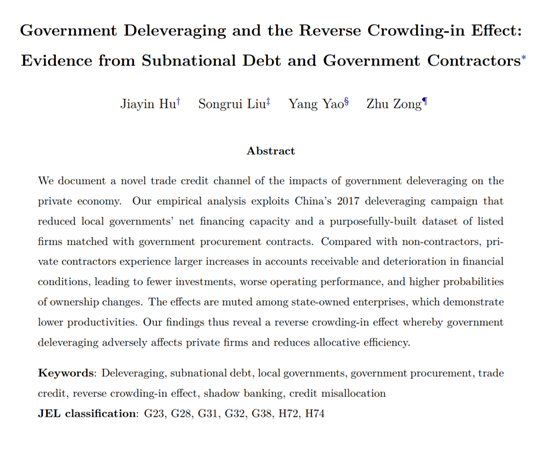
The core academic contribution of the Paper lies in its first-time proposal of the “reverse crowding-in effect” of government debt deleveraging. Existing literature often focuses on the “crowding-out effect” caused by the accumulation of government debt, with little analysis of the impact of government debt deleveraging. This research found that contrary to traditional understanding, subnational governments did not necessarily generate a symmetric “crowding-in effect” (i.e. release of credit resources) when implementing debt deleveraging. Instead, under the constraint of strictly controlling new debt, subnational governments transferred financial pressure by delaying payments to suppliers, significantly worsening the financial conditions of government contractors (especially private enterprises). These adverse effects were manifested in a higher proportion of accounts receivable, cash flow constraints, and increased equity pledges, which in turn inhibited enterprises’ investment and operational performance. This finding broke through the symmetric analysis framework of government debt impact in existing literature and revealed the mechanism through which deleveraging policies may trigger unintended consequences via supply chain transmission.
In terms of research methodology, the Paper constructed a matched dataset of A-share listed companies and subnational government procurement contracts from 2014 to 2019. Treating the 2017 deleveraging policy as an exogenous shock, it adopted a difference-in-differences (DID) model for causal identification. The empirical results showed that compared with enterprises not involved in government procurement, government contractors experienced a significant increase in the proportion of accounts receivable after the policy implementation. This effect was more pronounced in regions where subnational governments faced greater pressure to roll over existing debt. Notably, this negative impact was only observed among private enterprises and was not significant for state-owned enterprises (SOEs). This indicated that subnational government financing constraints may be selectively transmitted to the private sector via the government procurement channel, exacerbating the distortion of credit resource allocation.
The theoretical innovations of this research were reflected in three aspects: 1. It breoke through the symmetric perspective in the government debt literature, systematically demonstrating the asymmetric effects of government deleveraging via the trade credit channel, and filling the research gap regarding the economic consequences of deleveraging; 2. It expanded the dimension of government procurement research, shifting from traditional ex-ante bidding analysis to ex-post payment delay risks, and uncovering how the financial constraints of governments (as core buyers) were transmitted to the corporate sector via supply chains; 3. It deepened the understanding of fiscal-monetary policy interaction mechanisms, pointing out that against the backdrop of subnational governments’ reliance on shadow banking for financing, fiscal tightening triggered by deleveraging amplified the contractionary effect of monetary policy via the trade credit channel, thus providing new evidence for policy coordination.
In terms of policy implications, the research emphasized that subnational government debt risks exhibited systemic transmission characteristics. While the 2017 deleveraging policy restrained the financing capacity of urban investment companies in the shadow banking sector, it may have led subnational governments to transfer pressure through implicit means such as delayed payments, resulting in the phenomenon of “explicit deleveraging while implicit leveraging”. This risk transmission mechanism via supply chains suggested that debt risk prevention needed to go beyond the traditional fiscal perspective and attention should be paid to its spillover effects on the real sector. In particular, the negative impact of deleveraging was mainly concentrated on private enterprises, which may exacerbate credit misallocation and reduce capital allocation efficiency. This required policymakers to accurately assess the differentiated impacts when implementing deleveraging measures and avoid “one-size-fits-all” regulation.
Professor YAO Yang and his collaborators further pointed out that effective debt risk resolution required the coordinated cooperation of fiscal and monetary policies. As deleveraging policies were usually led by monetary authorities, their design must fully consider the response mechanisms of fiscal authorities, especially the supply chain transmission effects that may arise from fiscal expenditure behaviors such as government procurement. Notably, the Chinese government had recognized the severity of delayed payment issues and incorporated relevant governance measures into recent debt resolution plans, reflecting a profound understanding of the systemic nature of debt risks. The findings of the Paper provided important reference value for China’s ongoing efforts to coordinate the resolution of subnational government debt risks and offered useful insights from China’s experience for countries worldwide in addressing public debt accumulation in the post-pandemic era.
Paper Citation: Hu, Jiayin, Songrui Liu, Yang Yao, and Zhu Zong. 2025. “Government Deleveraging and the Reverse Crowding-in Effect: Evidence from Subnational Debt and Government Contractors.” Accepted at Management Science.