



On May 26, 2025, the 14th Salon themed “Dishui Lake Expert Insights" – Companies’ Response Strategies amid China-US Tariff Wave” (the “Salon” or “Event”), hosted by the Capital Market Research Center of Dishui Lake Advanced Finance Institute, Shanghai University of Finance and Economics (SUFE-DAFI), was held at Hongqiao Green Valley. Experts and industry elites from governments, business circle, and academia gathered at the Event to conduct in-depth discussion on the impact of tariff policies, industrial chain restructuring, and companies’ response strategies amid the current China-US economic and trade frictions.
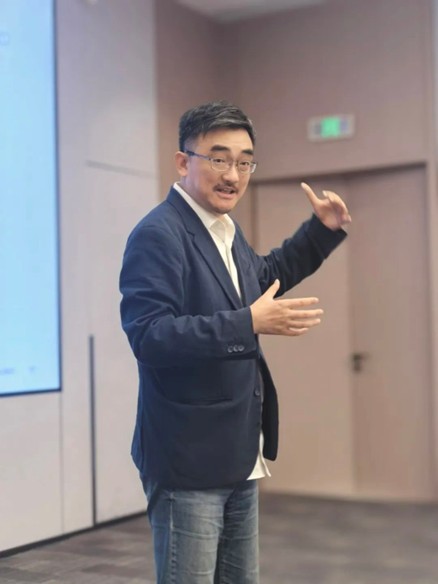
HE Zhiguo, Chair Professor of Finance at Stanford Graduate School of Business was specially invited to give lecture at the Salon. Starting from a historical perspective, Professor HE analyzed the underlying logic of the China-US tariff game, and he pointed out that the US tariff policies had shown significant historical continuity – from Alexander Hamilton’s advocacy of protecting the US manufacturing via tariffs, to Abraham Lincoln’s policy of sharply increasing tariffs to raise funds for the Civil War, and to Donald Trump ’s attempt to facilitate the re-shoring of the manufacturing sector via tariffs, representing the consistent policy context.
Taking the cell phone supply chain of Apple as an example, Professor HE pointed out the limitation of traditional method for calculating trade deficit. The US companies mainly gained profit from intellectual property rights and high-end design technologies, and concentrated their manufacturing in China. Current trade statistics system was mainly based on customs declaration data, so it could not accurately capture the complex division of labor in the value chains. Therefore, the entire value of “Made in China” products was counted in the US trade deficit with China. Such method was based on the general rules of the World Trade Organization (WTO), but failed to reflect the true distribution of modern global value chains.
When talking about the decoupling risk in the financial sector, Professor HE stated that "compared with the reshoring of the manufacturing sector, we shall pay more attention to the decoupling risk in the financial sector. The politicized application of the SWIFT system may accelerate the internationalization of RMB, but we shall maintain a prudent attitude toward China’s capital account liberalization."
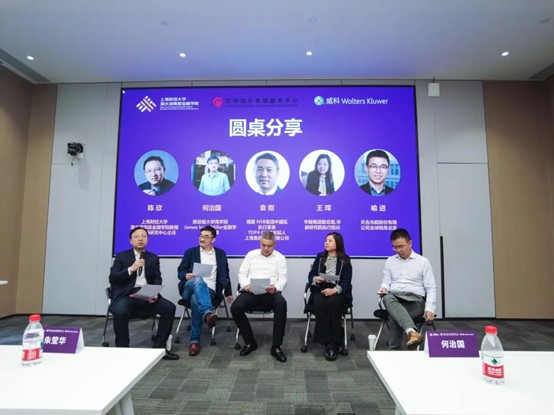
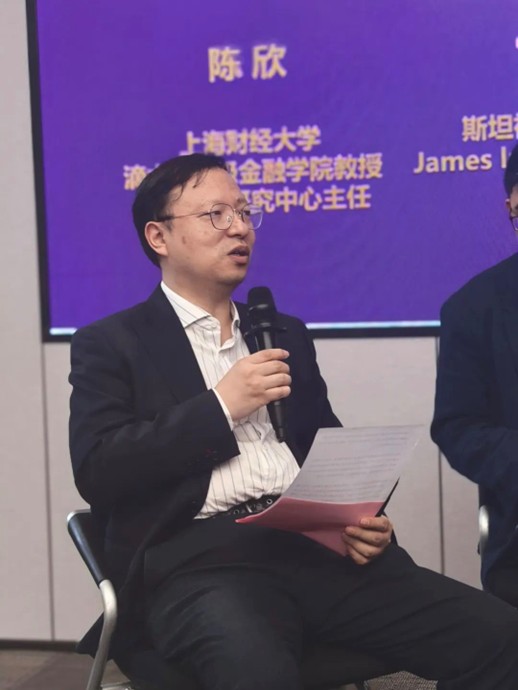
During the roundtable discussion session, Professor CHEN Xin from SUFE-DAFI hosted the in-depth dialogue with scholars and representatives from companies.
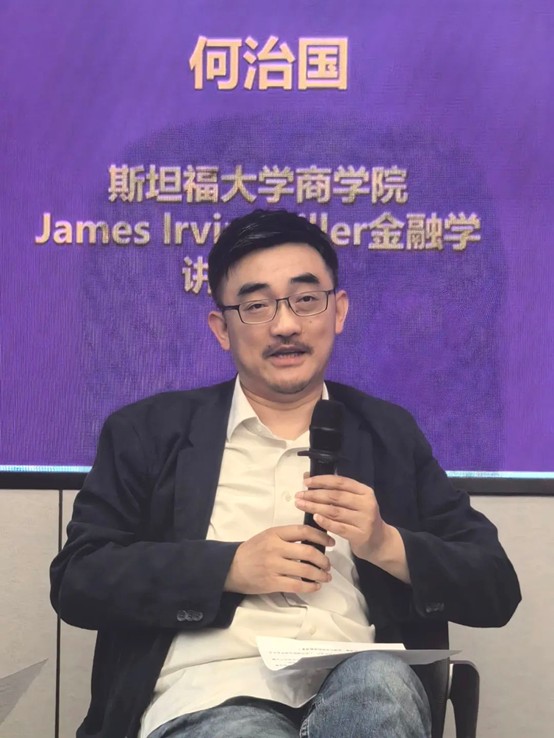
Professor HE Zhiguo elaborated that under the linkage between tariff conflicts and "China-US financial decoupling", companies should re-evaluate their financial strategies, e.g. cross-border capital flows and exchange rate hedging, and how Chinese companies going global should respond to related challenges.
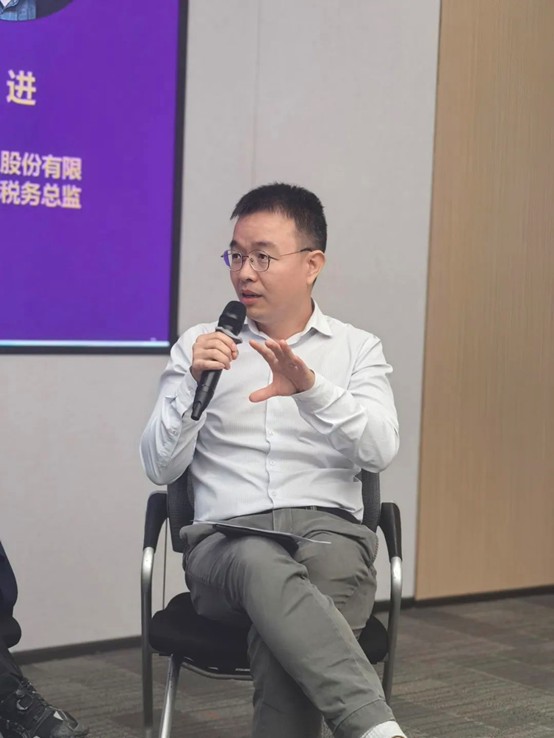
Photovoltaic (PV) Industry: YU Jin, Global Tax Director of Trina Solar, stated that since the PV industry experienced anti-dumping and countervailing as early as 2012, leading companies in the industry responded to tariff barriers by relocating their production bases to Southeast Asia and building factories in the US; despite some short-term impacts, China’s PV industrial chain maintained its irreplaceable advantages, so companies should pay close attention to the rules of origin and tax compliance.
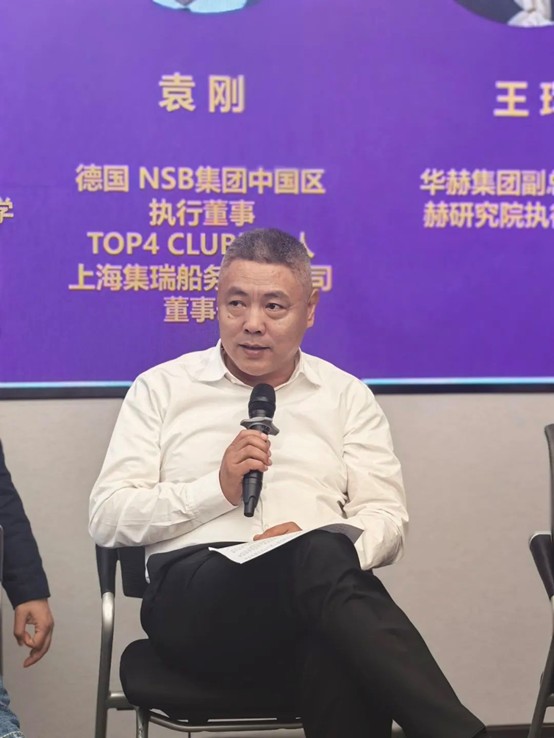
Shipping and Logistics: YUAN Gang, Executive Director of NSB Group China, pointed out that tariffs had an indirect and complex impact on shipping; with regionalization of supply chains, demand for branch shipping routes had increased, so companies should adjust their ship type structure to adapt to the changes in trade routes and pay attention to the impact of geopolitics on main shipping routes.
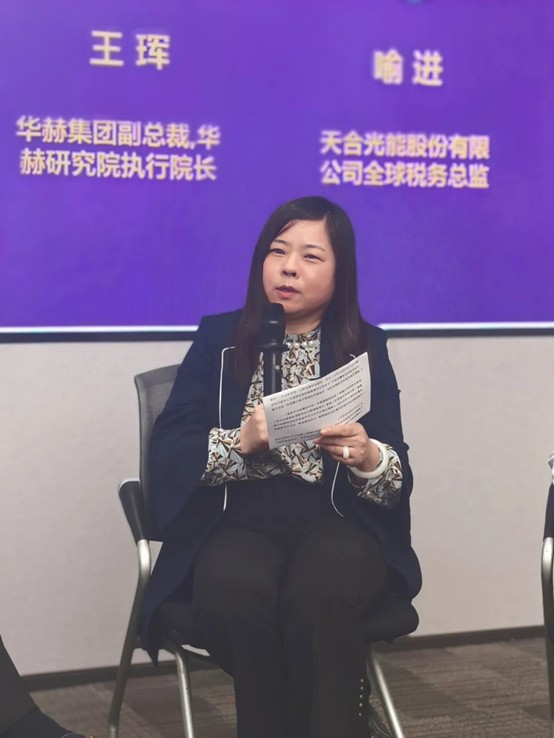
Tax Planning: WANG Hui, Vice President of Huahe Group, emphasized that Chinese companies going global should build a long-term collaborative compliance system integrating “finance, taxation, law, and business”, and avoid simplistic “production base relocation”, and she suggested companies to optimize their tax structures through tools such as group transfer pricing policies, free trade agreements, and tariff exemptions, and to prevent tax check risks in the host countries for investment.
The Salon provided a multi-dimensional perspective for companies to deal with tariff challenges. The tariff game has forced companies to accelerate their supply chain resilience construction and global layout. In the world of uncertainties, only by "responding to complexity with professionalism and hedging unilateralism with globalization" can companies go ahead steadily.
Co-organized by Hongqiao Overseas Development Service Center and Wolters Kluwer, the Event attracted representatives from companies in manufacturing, cross-border e-commerce, finance, etc.
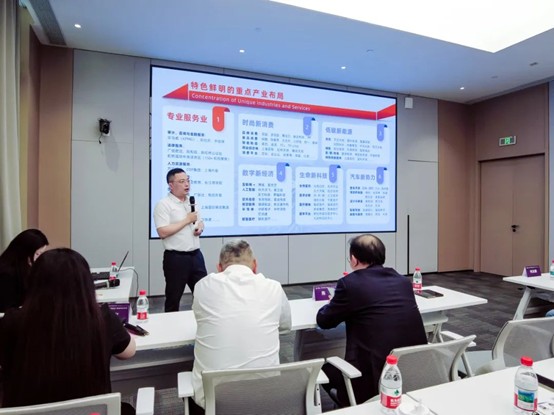
On the Salon, ZHU Yinghua, Director of the Investment Promotion and Public Service Center of the Management Committee of Shanghai Hongqiao International Central Business District (“Hongqiao CBD”), introduced the strategic positioning, development advantages, function layout, and future vision of Hongqiao CBD, and she pointed out that the China-US tariff game had a profound impact on the global economic pattern, and companies should keep track of policy trends and enhance their anti-risk capabilities in the complex situation.
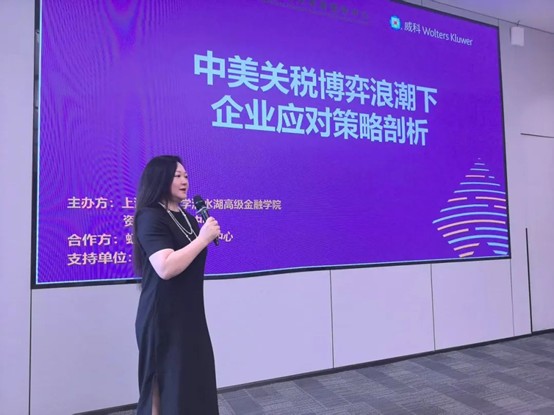
CHU Yile, Director of the Strategic Cooperation Department of SUFE-DAFI chaired the Salon. In the future, SUFE-DAFI will continue to join hands with partners to build more high-level enterprise practice-oriented dialogue platforms, so as to support Chinese companies move forward steadily in the global market.