




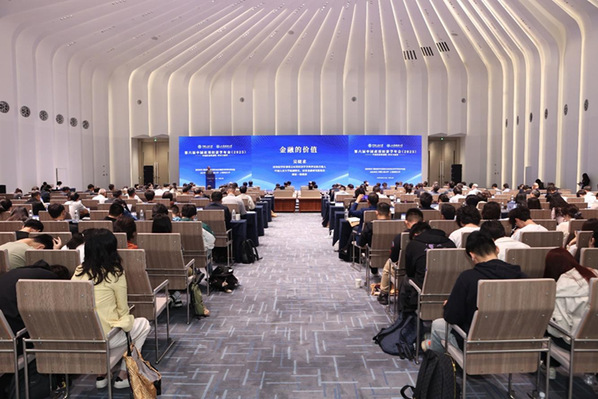
At a critical stage marked by profound adjustments in the global economic pattern and China’s comprehensive advancement of high-quality development, the 6th China Applied Economics Annual Conference (the “Conference”), co-hosted by Renmin University of China (RUC) and Shanghai University of Finance and Economics (SUFE), and guided by the Discipline Appraisal Group of the Academic Degree Commission of the State Council, was successfully held in Lingang, Pudong, Shanghai, from May 10 to 11, 2025.
With the theme “The Resilience of China’s Economy: Facts and Prospects”, the Conference brought together authoritative experts and scholars in the field of applied economics from across the country. They conducted in-depth discussions on key issues such as macro-policy design, paths of structural reform, industrial upgrading, and financial support.
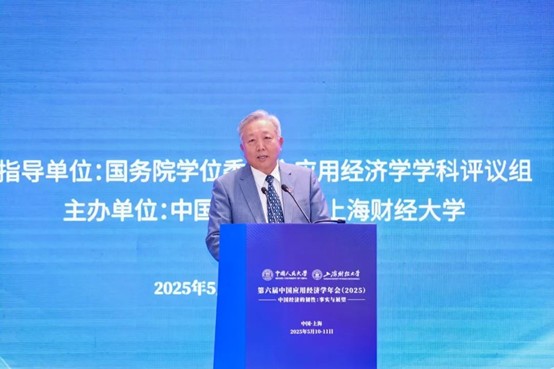
WU Xiaoqiu, Convener of the Discipline Appraisal Group of the Academic Degree Commission of the State Council, Former Vice President of RUC, Dean of the National Institute of Finance, and National First-class Professor, delivered a keynote speech titled “China’s Economic Strategic Choices and Financial Value Reconstruction”. From dimensions including the evolution of the global pattern, internal institutional innovation, external demand expansion, and the evolution of financial functions, he built an academic framework for analyzing the path of China’s economic modernization. The following was an excerpt of the key points from his speech.
I. Building Institutional Civilization to Solidify Strategic Fulcrums for Economic Growth
Professor WU Xiaoqiu pointed out that China’s manufacturing sector accounted for over 30% of the world’s total, marking a historic milestone indicating that China’s economy had basically leaped from a global manufacturing power to a leader in industrial system strength. In the future, China should plan its development from the strategic height of the rise of a civilization-type country.
He emphasized that sustaining long-term, sustainable economic growth could not rely solely on scale and inertia; it must be rooted in institutional civilization to build an institutional system supporting a modern powerful country. Specifically, China’s economy must establish three strategic fulcrums for the following aspects: 1. Accelerating the improvement of a market economy system ruled by law, and achieve institutional breakthroughs in areas such as property rights protection, fair competition, and credit governance; 2. In terms of the domestic demand system, advancing income distribution reform, enhancing social security capabilities, stabilizing consumption expectations, and building a stable consumption structure centered on the middle-income group; 3. In terms of opening-up strategy, promoting higher-level institutional opening-up, proactively participating in the formulation of Global Trade Rules Version 2.0, especially taking initiative to break down market barriers in developed countries.
II. Reshaping the Domestic Demand Structure: Institutional Responses from Income Mechanisms to Consumption Confidence
Professor WU Xiaoqiu noted that in respect of the practical challenge of expanding domestic demand, it was not China’s consumption capacity but that institutional incentives were insufficient. The core issues currently lay in the intertwined relationship of unbalanced income structure, unstable consumption expectations, and constraints from social security. He proposed that systematic institutional reforms were essential to consolidate the underlying logic of domestic demand-driven growth.
First, a more equitable and sustainable income distribution system should be established. By improving the primary distribution mechanism, strengthening the regulatory role of redistribution, and enhancing the efficiency of tertiary distribution, an “olive-shaped” structure should be gradually formed. This would increase the proportion of the middle-income group and release structural consumption potential. Second, consumption confidence should be stabilized by enhancing policy transparency and stability. This required building a cross-cyclical macro-regulation framework to stabilize residents’ expectations for the future at the institutional level. Third, substantial breakthroughs should be made in the construction of the social security system. A universal, unified, and standardized social security network should be established to reduce the motivation for precautionary savings and stimulate the overall consumption propensity of society.
Professor WU Xiaoqiu emphasized that domestic demand-driven growth was not only an economic proposition but also a comprehensive test of institutional supply. By establishing “equality for market entities” and “fair competition rules”, a truly modern market economic order could be achieved, thereby releasing sustained and stable micro-level momentum.
III. Proactively Participating in the Reconstruction of Global Rules to Promote the Transformation and Upgrading of the Opening-up Strategy
When discussing China’s international economic strategy, Professor WU Xiaoqiu pointed out that China’s global role in the economy was undergoing a key shift from “integrating into the global system” to “participating in its reconstruction”. Against the background of “dual circulation” development pattern, China should not only pursue the expansion of export share but also shape a new pattern of opening-up. He emphasized that to understand the structural logic of China’s opening-up strategy, we must adopt a “dual-driver” perspective: On the one hand, nearly 50% of China’s production capacity still relied on the global market for absorption, so it was essential to continuously maintain an open world economic system; on the other hand, China must proactively strive for the right to formulate international rules and put forward Chinese solutions in areas such as WTO reform, digital trade, and green finance.
Professor WU Xiaoqiu noted that China should promote the construction of a more inclusive and equitable “Global Trade Rules Version 2.0”. In particular, in Sino-U.S. economic and trade interactions, it should explore a new mutually beneficial rule model to break the trend of trade fragmentation. In terms of market expansion, while maintaining cooperation with developing countries, China should accelerate access to the core markets of developed economies to build a stable, long-term, and diversified external demand structure.
He emphasized that truly resilient opening-up did not lie in passively accepting rules, but in shaping institutional capabilities, discourse power, and strategic layout in a trinity. This was a necessary prerequisite for the leap of China’s economic influence in the global arena.
IV. Restoring the Essence of Finance to Promote the Leap of Modern Economic Institutional Civilization
In the latter part of his speech, Professor WU Xiaoqiu delved into the institutional attributes and value foundation of finance. He pointed out that finance was not only a resource allocation mechanism but also a manifestation of institutional civilization. From a historical perspective, the maturity level of a financial system often determined the operational efficiency of a country’s market system, the structure of wealth distribution, and the transparency and contractual nature of its governance system.
Professor WU Xiaoqiu explained the modern value system of finance from four dimensions: 1. As a basic institution: Finance built the technical foundation for market operation through value scales, payment media, and settlement methods; 2. As an allocation mechanism: Finance guided the efficient allocation of resources through risk pricing and capital flow, providing capital support for sci-tech innovation and industrial upgrading; 3. As a wealth management system: Finance must serve the needs of the people for wealth security and returns, build a multi-level capital market, and improve wealth liquidity and the efficiency of savings conversion; 4. As a carrier of civilization: Financial system promoted the widespread establishment of social transparency, rule awareness, and the spirit of contract, largely guiding the formation and development of a modern society ruled by law.
He specifically noted that China was currently being in a stage of “dual disintermediation”: Market-based disintermediation drove the rise of direct financing, while information-based disintermediation reshaped financial infrastructure, promoting the rapid development of new business formats such as platform finance and robo-advisory. This historic evolution of the financial structure meant that finance would leap from a traditional “financing intermediary” to a “resource allocation hub” and a “catalyst for institutional civilization”.
V. Taking Institutions as the Foundation and Civilization as the Direction: China’s Economy Entering a New Stage
At the end of his speech, Professor WU Xiaoqiu proposed that the next stage of China’s economic growth would depend not only on factor input and policy adjustments but also on the systematic evolution of the institutional system and the rational reconstruction of social values. Finance should not be regarded as a “hotbed of original sin” in the economy, but as the infrastructure for market equity, public trust system, and modern civilization. Economists should assume the responsibility of institutional innovation and the mission of interpreting civilization. They should abandon biases such as “financial aversion” and “anti-market sentiment”, and use academic professionalism and policy influence to jointly participate in the modernization of the national governance system and governance capacity.
Professor WU Xiaoqiu’s speech outlined a clear cognitive path, helping participants more systematically understand the internal logic of China’s economic transformation amid the complex global pattern. This path started with strategic positioning, consolidated the foundation of domestic demand through institutional reform, strived for discourse power in global governance through higher-level opening-up, and ultimately promoted the in-depth evolution of institutional civilization through the modern reconstruction of the financial value system. The four-dimensional analytical framework of “Institution-Strategy-Value-Civilization” he proposed not only provided strong explanatory power for China’s high-quality economic development but also injected theoretical clarity and path confidence into Chinese path to modernization.
As various reforms continue to advance in depth, China’s economy will move toward a more profound new chapter of development as being driven by both institutional maturity and consensus on civilization.