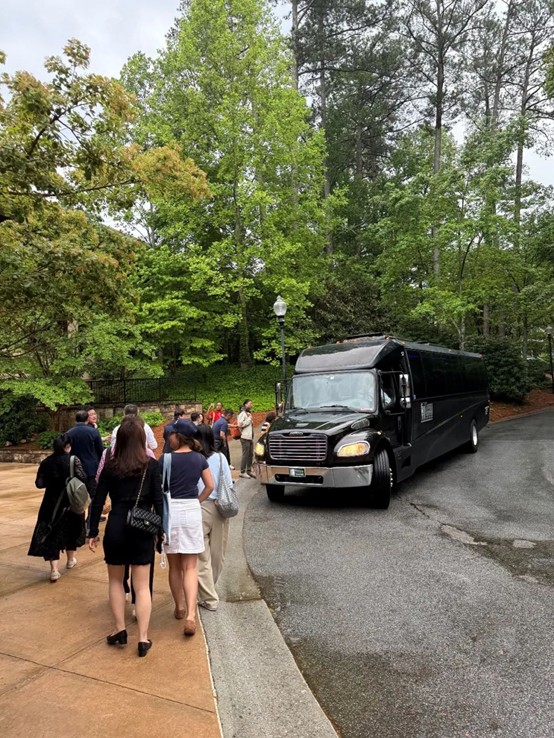



From May 2 to 3, 2025, Dishui Lake Advanced Finance Institute, Shanghai University of Finance and Economics (SUFE-DAFI) and Emory University's Goizueta Business School continued to advance the SUFE-Emory Program - an international study trip module themed "Artificial Intelligence (AI) and Global Business Leadership" (the “Program”).
In the Modern Business Management module, the Program focused on four areas: organizational behavior, strategic planning, management consulting, and green product design. The courses were jointly delivered by four professors from Goizueta Business School and corporate executives, helping participants systematically build a structured management thinking framework and enhance practical capabilities through multi-dimensional case exercises.
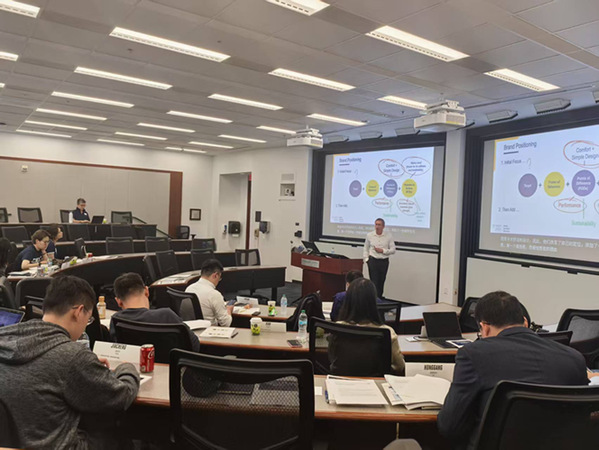
The Underlying Structure of Organizational Leadership
On the morning of May 2, 2025, Richard Berlin, Associate Professor in the Practice of Organization & Management at the Goizueta Business School, delivered a course focusing on leadership and self-awareness. Starting with employee engagement data, the course introduced five common traits of "highly effective managers": trustworthiness, vision orientation, influence without authority, high emotional intelligence (EQ), and learning agility. Professor Berlin pointed out that excellent managers needed to make judgments in uncertain environments, rather than relying solely on positional authority.
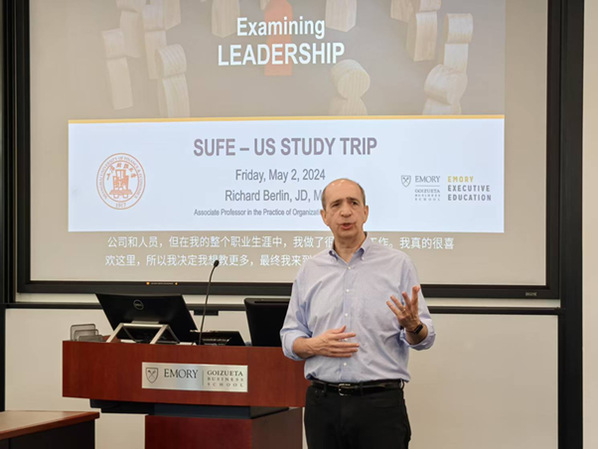
Professor Berlin also introduced Daniel Goleman’s Six Leadership Styles Model in the course, guiding participants to identify and reflect on their own leadership preferences. In the "Self-awareness" module, participants completed internal and external cognitive assessments based on TASHA Eurich’s theory, identified common cognitive blind spots, and improved their ability to adjust themselves and receive feedback. Professor Berlin emphasized that a manager should first be someone who remained highly sensitive to themselves and their environment.
Solving Complex Problems with Structured Thinking
In the subsequent “Management Consulting” course, Professor Berlin focused on the structured problem-solving methods commonly used by consultants, emphasizing that “the core of consulting was not to provide answers, but to define the right problems”. Through the case of VitalWell (a fitness brand), he guided participants to reconstruct customer demands based on the “Six Principles of Problem Definition”, and used the MECE (Mutually Exclusive, Collectively Exhaustive) Principle and Pyramid Principle for logical decomposition and expression construction.
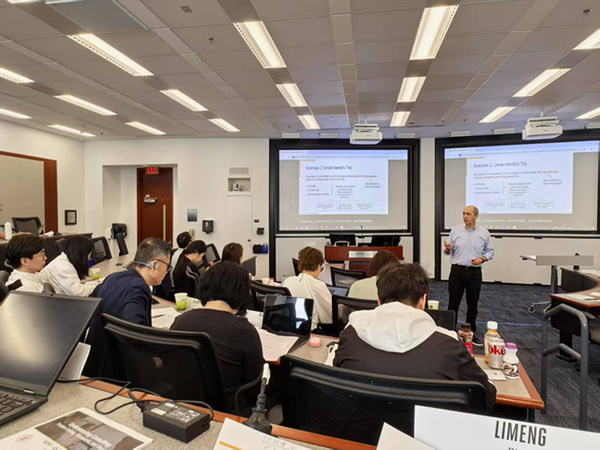
Professor Berlin stressed that future managers needed to master three basic capabilities: structured thinking, influence without authority, and storytelling. The course trained the foundation of management analysis through the path of “Structure - Behavior - Expression”, and built a complete problem-solving framework in simulation drills.
Reconstruction of the Education Industry from an AI Perspective
On the afternoon of the same day, Josh Jones, CEO of QuantHub, gave a lecture themed “AI Innovation in Educational Technology”, focusing on the technological evolution and application logic of generative AI. He pointed out that AI was driving simultaneous changes in educational models, talent capability structures, and business boundaries, and traditional skill structures were facing accelerated iteration.

Combining his own entrepreneurial experience, Jones explained prompt engineering, AI model evaluation, and skill transformation paths, emphasizing that “technological literacy” had become a core competency. He specifically noted that ethical design and judgment mechanisms in AI deployment would become key issues in future entrepreneurship and governance, and suggested that organizations should, in addition to improving efficiency, simultaneously consider the redefinition of collaboration mechanisms and human-machine relationships.
The Value of Strategy Lies in Implementation
On the morning of May 3, 2025, Professor Mark Myette, Management Consultant, delivered a “Strategic Planning” course. Centered on commonly used tools such as Strengths, Weaknesses, Opportunities, Threats (SWOT) Analysis, Specific, Measurable, Achievable, Relevant, Time-bound (SMART) Goal Method, and Balanced Scorecard, the course helped participants systematically figure out the path of strategy from formulation to implementation. Professor Myette pointed out that many enterprises “had strategies but failed to implement them”; the problem was not wrong direction, but a lack of clear implementation mechanisms and incentive models.
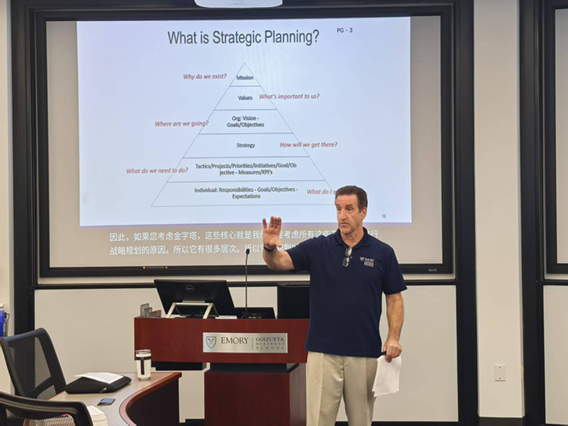
In the sand table drill session, participants set roles and deduced time paths around the “Tactical Execution Framework”, building an operable chain from goals to implementation. Professor Myette emphasized that the realization of strategic value depends on the maturity of internal coordination mechanisms and the reasonable setting of incentive systems within the organization.
Green Design: An Extension of Corporate Core Value
Subsequently, Doug Bowman, Professor of Marketing at the Goizueta Business School, delivered the “Product Design and Green Innovation” module, focusing on the impact of Environmental, Social, Governance (ESG) on consumption trends and product development paths. Professor Bowman pointed out that green design was no longer an add-on, but an important extension of corporate core value. Using cases such as ClimaGuard’s eco-friendly cardboard and Bosch’s tool rental service, the course demonstrated how ESG enhanced product premium and brand recognition.
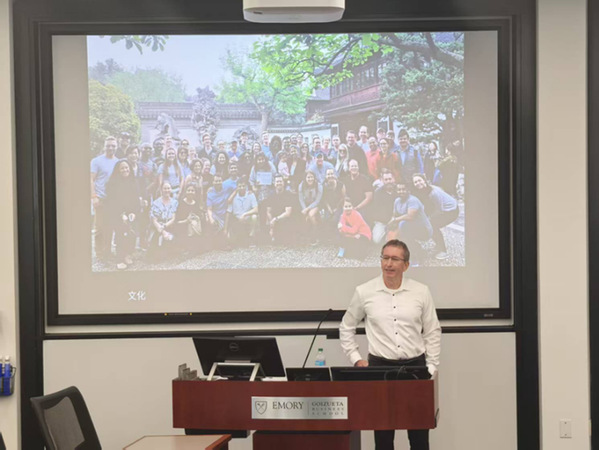
At the class, Professor Bowman guided participants to use Conjoint Analysis and Jobs to Be Done (JTBD) Theory to convert user needs into product value propositions, and completed a “zero-carbon footprint cultural and creative products” design exercise combined with practical projects. Professor Bowman emphasized that sustainable design should align with business goals, and data-driven approaches and social value can go hand in hand.
The two-day “Modern Business Management” module helped participants expand their capabilities in structured tools, strategic vision, and collaborative judgment. From organizational leadership to green product innovation, from consulting-style analysis to strategic execution mechanisms, the course used a series of transferable tools and real cases to guide participants in establishing clear problem awareness and systematic problem-solving capabilities in complex environments.
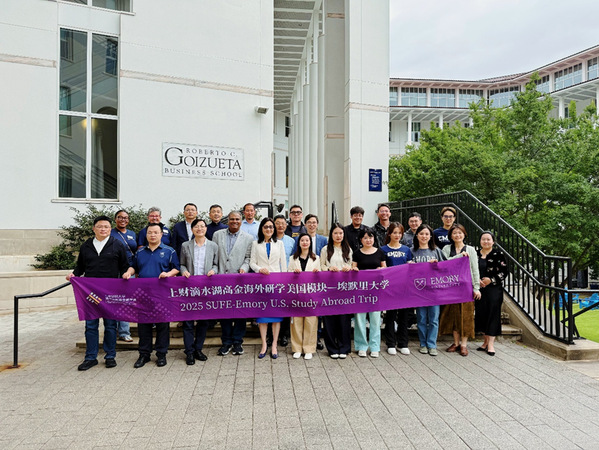
This study abroad trip was led by WANG Wei, Director of the Executive Education Center of SUFE-DAFI, andFANG Limeng from the MBA Center of SUFE-DAFI. The group visited Emory University’s Goizueta Business School in Atlanta, USA, opening a new chapter in the joint cultivation of international talents between the two institutions. SUFE-DAFI has always taken “multi-dimensional understanding, in-depth judgment, and systematic action” as the core logic for cultivating future managers. In addition to in-class lectures and industry sharing, this study abroad trip also included wonderful on-site visits to benchmark enterprises and group project drills, further verifying the practical transformation ability of the study results.
For more exciting campus highlights, please click below↓