



2025-05-05
May 5, 2025
In April 2025, Dishui Lake Advanced Finance Institute, Shanghai University of Finance and Economics (SUFE-DAFI) and Emory University's Goizueta Business School jointly launched theSUFE-Emory Program - an international study trip module themed "Artificial Intelligence (AI) and Global Business Leadership" (the “Program”). The Program focused on the in-depth application of AI in business, management, finance and governance. In the Program, courses were jointly delivered by seven professors from the Goizueta Business School, thus building a scientific learning path from technology understanding to strategic thinking.
This study trip was led by WANG Wei, Director of the Executive Education Center of SUFE-DAFI, and FANG Limengfrom the MBA Center of SUFE-DAFI, and the participants received warm reception from the Goizueta Business School.
As a key part of this study trip, the courses related to AI covered critical topics in the industry such as human-AI collaboration, AI business scenarios, financial trading models, and technology governance system, which were delivered by four professors from the Goizueta Business School. After learning these courses, the participants could develop multi-dimensional judgment amid the rapid evolution of complex technologies.
In the course "AI and Future Work", starting with "the long-term impact of AI on workplace" Rajiv Garg, Associate Professor of Information Systems at Emory University stated that AI was not only an automation tool, but also was reshaping the ways of humans’ collaboration and organization; and he pointed out that as AI was widely allied in scenarios such as intelligent warehousing and customer service operations, the number of repetitive jobs would decrease significantly, while cognitive and creative jobs would predominate.
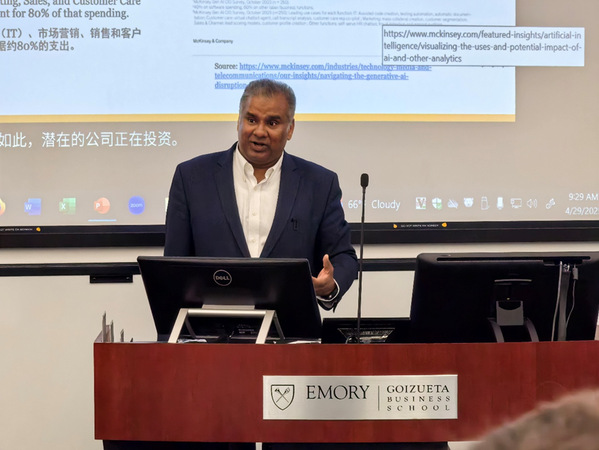
During the class, Professor Garg guided the participants to discuss how talents’ ability structure updated in the AI era, including the new skills such as prompt engineering, data optimization, and cross-system collaboration. He emphasized that "the real challenge is not what personnel will be replaced by AI, but whether we are ready to collaborate with AI". In the "Golden Model of Human-AI Collaboration" designed by Professor Garg, the combination of Human and AI outperforms either humans working alone or AI working alone, thus laying a foundation for subsequent contents of the course including business implementation and technical risk.
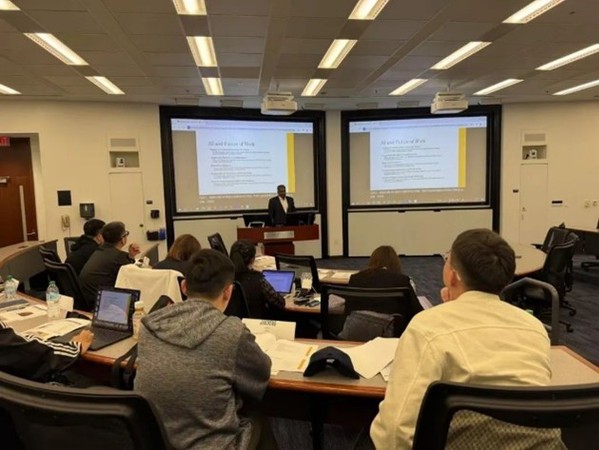
In his lecture titled “Applications of AI in Business”, David Schweidel, Professor of Marketing, showed the participants how AI was reshaping enterprises’ decision-making logic and execution models. He summarized applications of AI in business as a "data-analysis-action" loop, and analyzed how AI improved efficiency in dynamic pricing, content generation, and customer services, based on practical cases of Polestar, Orbitz, Moderna, etc.
For example, Polestar optimized its advertising graphics and texts using generative AI, resulting in an increase the click-through rate by nearly 50%; Orbitz optimized pricing for users based on their operating systems, leading to significantly improved conversion rates; and Moderna applied models in drug research and development to reduce the document processing time, thus accelerating the approval process effectively.
Professor Schweidel pointed out that in addition to its advantage in efficiency, AI’s true value lied in "reproducible intelligent judgment capability". He reminded enterprises to maintain supervision from humans when applying AI, so as to avoid experience gaps caused by algorithmic biases. From his lecture, the participants gained a large number of transferable industry cases, especially in content marketing and user operation.
In his lecture on "Applications of AI in Securities Trading and Asset Management", Tucker Balch, Professor of in the Practice and Research of Finance, led participants to comprehend the practical effectiveness of AI technologies such as reinforcement learning (RL) in investment strategy modeling. Professor Balch explained portfolio optimization with a lunar lander, demonstrating the advantages of RL models in balancing risk and return. He also stated that RL models maintained stable performance in terms of Sharpe ratio and maximum drawdown control and worked better than traditional mean-variance models in backtesting.
Professor Balch also demonstrated ABIDES, a mock trading platform co-developed by him, revealing the "learning path" of AI in high-frequency trading, including how AI developed manipulative behaviors without humans’ guidance, e.g. guiding price fluctuations by using fake orders. These demonstrations invoked the participants’ reflection on “design of technical objective function", i.e. whether the optimization goals of AI systems conformed to moral codes and regulatory requirements.
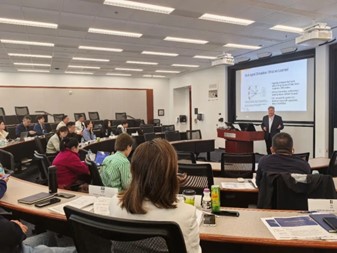
"The risks of financial AI do not lie in the technology, but in whether the behavioral boundaries we give to it are clear," Professor Balch said, and he pointed that future algorithmic trading not only should conform to regulatory requirements, but also should be designed from an ethical perspective.
In her lecture on “Financial System Governance in the Era of Big Data and Technology”, Wei Jiang, Vice Dean of the Goizueta Business School and Candler Chair Professor, explored the impact of AI, blockchain and other cutting-edge technologies on traditional financial rules and ethics from the perspective of the interaction between regulations and technologies. Besides, Professor Jiang pointed out that AI was gradually transforming into an "agent" from a "tool", so traditional entrustment-agency theory couldn’t cover the complex games involving current algorithms.
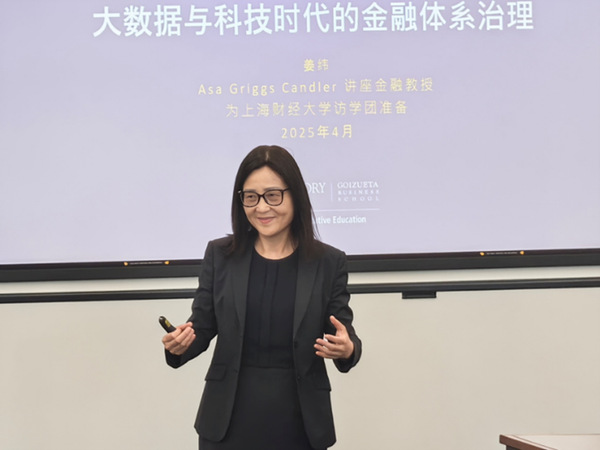
During the course, Professor Jiang analyzed typical risks such as "objective function imbalance", "abuse of alternative data", and "rigid execution of smart contracts"; by taking the systemic feedback risks caused by contingent convertible bonds as an example, she explained technological transparency didn’t mean risk controllability; and she put forward that the future financial governance system would require interdisciplinary capabilities, including the capability to understand technologies, the capability to judge ethic, and the capability to design mechanisms.
The “Centaur Model” (a human-AI co-governance architecture) designed by Professor Jiang was one of the key concepts of the course: humans lead value judgment and direction-setting, and AI undertakes information processing and execution. This Model provided the participants with a thinking framework to understand the new financial governance logic, and improved the in-depth logic from application to institution of the course.
Upon multi-day modular courses, the participants not only systematically comprehended typical applications of AI in organization, business, finance, and governance, but also developed structured thinking to deal with the uncertainties and complexities caused by new technologies:
·Knew the human-AI collaboration mechanism and the evolution of humans’ role in future work;
·Acquired data-driven business optimization models and established the ability to evaluate AI-related implementation scenarios;
·Improved the awareness of algorithmic risks and market manipulation risks in the financial market;
·Built an analytical framework for technologies, ethics and rules so as to provide theoretical support for dealing with potential governance challenges.
In the first chapter of the five-day Program, the participants from SUFE-DAFI no longer asked "whether AI was worth using", but put forward deeper questions, e.g. "how AI should be used". The collaboration logic, efficiency models, behavioral boundaries, and regulations together formed a complete cognitive path.
As one participant stated after the Program, "AI is not only a kind of technology, but also a mirror of the future of organizations. We not only learn about AI, but also learn how to judge".
When cultivating future-oriented managers, SUFE-DAFI never just pile up a variety of technologies, but builds judgment ability amid complexity and upholds a sense of order amid changes. The exploration in Emory’s classroom is not only a footnote in SUFE-DAFI’s global education journey but also a proactive attempt for systematic thinking in the era of technology.