



In March 2025, Dishui Lake Advanced Finance Institute, Shanghai University of Finance and Economics (SUFE-DAFI) successfully launched the Module 4 of the “Global Leadership Program in New Finance (Phase II)” (the “Module”) at its Guoding Road Campus. Centered on the theme of “Artificial Intelligence and Its Applications in Finance and Industry”, this Module brought together four top experts in the AI field to delve into the scientific fundamentals of AI, the operating principles of large models (LMs), and their cutting-edge applications in the financial industry.
Professor DENG Xiaotie, Chair Professor at the Frontier Computing Research Center of Peking University and Director of the Blockchain Committee of the Chinese Society for Industrial and Applied Mathematics (CSIAM), delivered a keynote speech titled Intelligent Learning Challenges in Financial Economics, exploring how AI was transforming the financial sector. Professor DENG argued that AI was not merely a more efficient tool but a key driver reshaping the financial ecosystem. By comparing the development of the four eras of manual bookkeeping, mechanical technology, computers, and AI, he pointed out: “The uniqueness of AI lies in making data itself a source of value. While past technologies processed data faster, AI proactively discovers patterns from data and creates decision-making value.”
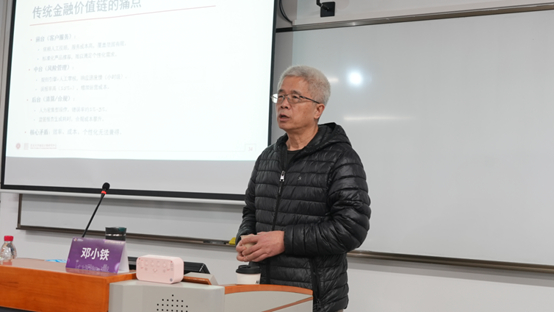
This transformation has triggered a radical shift in financial operation models: moving from relying on “human-defined rules” to “data-driven decision-making”, and further evolving into “intelligent networks with collaboration among multiple AI systems”. Specifically, this shift is reflected in three transformations:
①Upgrade of Data’s Role: From simply recording information to directly generating value;
②Evolution of Decision-making Methods: From fixed formula-based calculations to dynamic adaptation to market changes;
③Breakthrough in Knowledge Collaboration: From human expert-led work to collaborative work among AI systems.
Professor DENG’s research suggests that financially successful institutions in the future need to achieve the two goals below:
①Deeply Understand the Essence of Finance: Grasping, for example, the laws of market volatility and risk control principles to avoid over-reliance on algorithms that lead to decision-making failures;
②Build Technological Advantages: Establishing core competitiveness by accumulating unique data, enhancing computing capabilities, and cultivating interdisciplinary teams proficient in both finance and AI.
Ultimately, AI will not replace the core goals of finance, rational capital allocation, risk management, and trust-building, but will help humans achieve these goals in more complex environments. The true winners will be institutions that deeply integrate AI technology with financial wisdom.
YANG Yanqing, Chief Strategy Officer of the Shanghai Institute for Scientific Intelligence and Adjunct Professor at Fudan University, shared insights into the theme of “Cutting-edge Scientific Intelligence and AI Economics”. She introduced the concept of “AI4S (AI For Science)”, emphasizing the in-depth integration and mutual empowerment of AI and scientific research. She elaborated on the groundbreaking applications of AI in fields such as life sciences, material sciences, atmospheric environment, and social sciences.
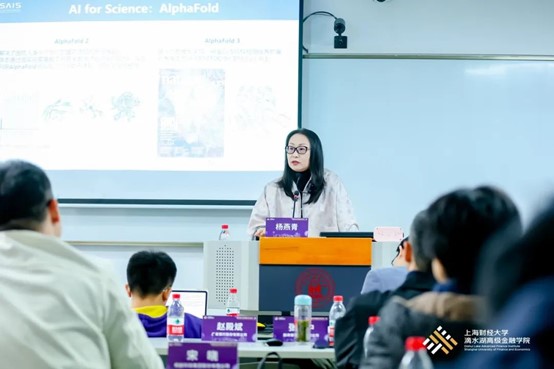
Professor YANG specifically analyzed the case of DeepSeek, noting that its breakthroughs in performance, cost, and open-source development marked the arrival of AI’s “Watt Moment”; and this represented a development path unique to China achieved through algorithmic and integrated innovation that was different from hardware “scaling laws”. She emphasized that China’s complete and efficient manufacturing supply chain, along with the world’s largest pool of AI scientists, engineers, and domain specialists, would serve as strong advantages for China in AI R&D and application. For enterprises seeking transformation in the AI era, Professor YANG advised focusing on digital foundational capabilities and process reengineering to fully leverage AI’s productivity potential as a general-purpose technology. Meanwhile, she suggested that China should formulate relevant macroeconomic policy frameworks as early as possible, starting from the perspectives of macroeconomics and the labor market.
KONG Lingpeng, Assistant Professor in the Department of Computer Science at The University of Hong Kong, explained the underlying logic of large language models (LLMs) in a vivid manner. He compared generative language models to a process of “constantly rolling dice to predict the next character”, pointing out that this mechanism shared similarities with how humans learned language. Professor KONG systematically explained the key stages of LLM training: pre-training, fine-tuning, and instruction tuning. He emphasized that when the model scale reached a critical point, it exhibited “emergent abilities”, demonstrating intelligent behaviors beyond expectations.
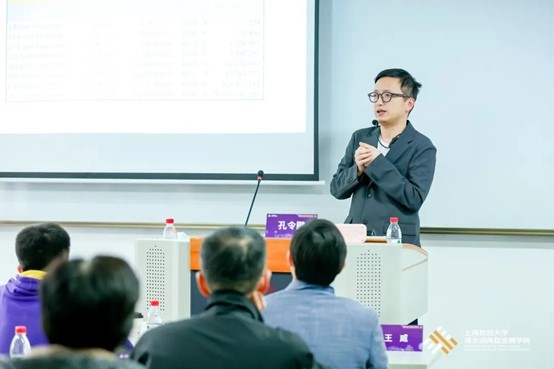
Regarding the issue of AI “hallucinations”, Professor KONG suggested increasing high-quality training data and adopting technical methods such as chain-of-thought to improve reasoning accuracy. He argued that distributed AI and federated learning would become key trends in LLM development, as they not only enhanced resource utilization efficiency but also effectively protected user data privacy.
YANG Qiang, Fellow of the Canadian Academy of Engineering and the Royal Society of Canada, Dean of the Advanced Institute of AI at The Hong Kong Polytechnic University, and Chief AI Advisor at Webank, explored the nature of AI LMs and their wide-ranging applications in finance from both philosophical and practical perspectives. He summarized the development of AI as an evolutionary process of human-computer interaction: building a communication bridge using data as a translational medium, and enhancing the model’s cognitive dimensions through more data, greater computing power, and more efficient algorithms.
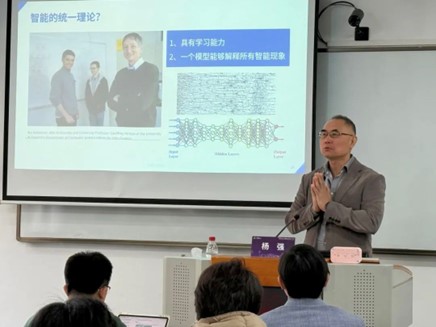
Professor YANG highlighted the fundamental difference between discriminative AI and generative AI: “Intelligence has two dimensions - discrimination and generation. Everyone possesses discriminative abilities, but not everyone has generative abilities.” Facing the bottleneck of public domain data depletion, he pointed out that the integration of federated learning, transfer learning, and LMs would be the future direction. At the business model level, Professor YANG distinguished between the conceptual evolution of “+AI” (AI as a tool to assist humans) and “AI+” (AI-led, human-machine collaboration), predicting that the financial industry was on the verge of a structural transformation. He particularly called for increased investment in basic scientific research on AI, concluding: “In the AI era, asking good questions is more competitive than providing good answers, for this reflects humanity’s most precious and irreplaceable creativity.”
In addition to academic courses, this Module also featured the “Pilot Leadership Symposium” (the “Symposium”), a carefully orchestrated class activity, themed by “Exploring the Century-old SUFE and Appreciating Business Culture”. Through an in-depth study tour bridging history and the future, the Symposium built a bridge for participants to connect traditional business wisdom with cutting-edge technological thinking.
During the immersive experience at the SUFE History Museum, participants traced SUFE’s century-long journey and gained insights into the evolutionary code of financial civilization. Subsequently, they explored the achievements of SUFE’s industry-academia-research collaboration with financial institutions and the Lingang New Area, experiencing the sparks of innovation generated by the intersection of theory and practice. To align with the Module’s theme, a VR Experience Exhibition of The Eternal Notre-Dame de Paris was also arranged, allowing participants to experience the perfect integration of digital technology and humanities. This sparked lively discussions on industrial transformation in the AI era. The Symposium provided business leaders with a knowledge expansion platform beyond traditional classrooms, leading to new dimensions of cross-border innovation and strategic decision-making through in-depth executive dialogues and ideological exchanges.
The Global Leadership Program in New Finance (Phase II) covers six modules: “Macroeconomics and the New Development Pattern”, “International Development and Chinese Practice of ESG”, “Pioneer Industries and Cutting-edge Sci-tech Innovation”, “Artificial Intelligence and Its Applications in Finance”, “Management Innovation and Leadership Development in the Digital & Intelligent Era”, and “High-quality Development, Financial Powerhouse, and the ‘Five Key Areas in Finance’”. From macro strategy to micro practice, and from theoretical exploration to hands-on drills, these modules fully cover the latest development trends and cutting-edge achievements in new finance and new industries.
Stay tuned for the next module!