


Original by SUFE-DAFI, Published at 13:31, Aug 24, 2023 in Shanghai

created by a company?
is there anything recorded
on nature’s ledger?
is there a place
for social responsibility?
is there always awe
in heart?
Environmental protection, social responsibility, corporate governance
SUFE-DAFI has launched an ESG Feature column – in which our teachers are invited to share ESG research and discuss the future path to sustainable development, so that ESG could lead the green age and contribute to a sustainable future!

A paper titled “Employee Costs of Corporate Bankruptcy” – authored by Qiu Jiaping, visiting professor at SUFE-DAFI, and his collaborators – has been recently published in The Journal of Finance, a top journal in finance.

Please click “Read the Original Text” to access the paper’s electronic version.
About the Journal
The Journal of Finance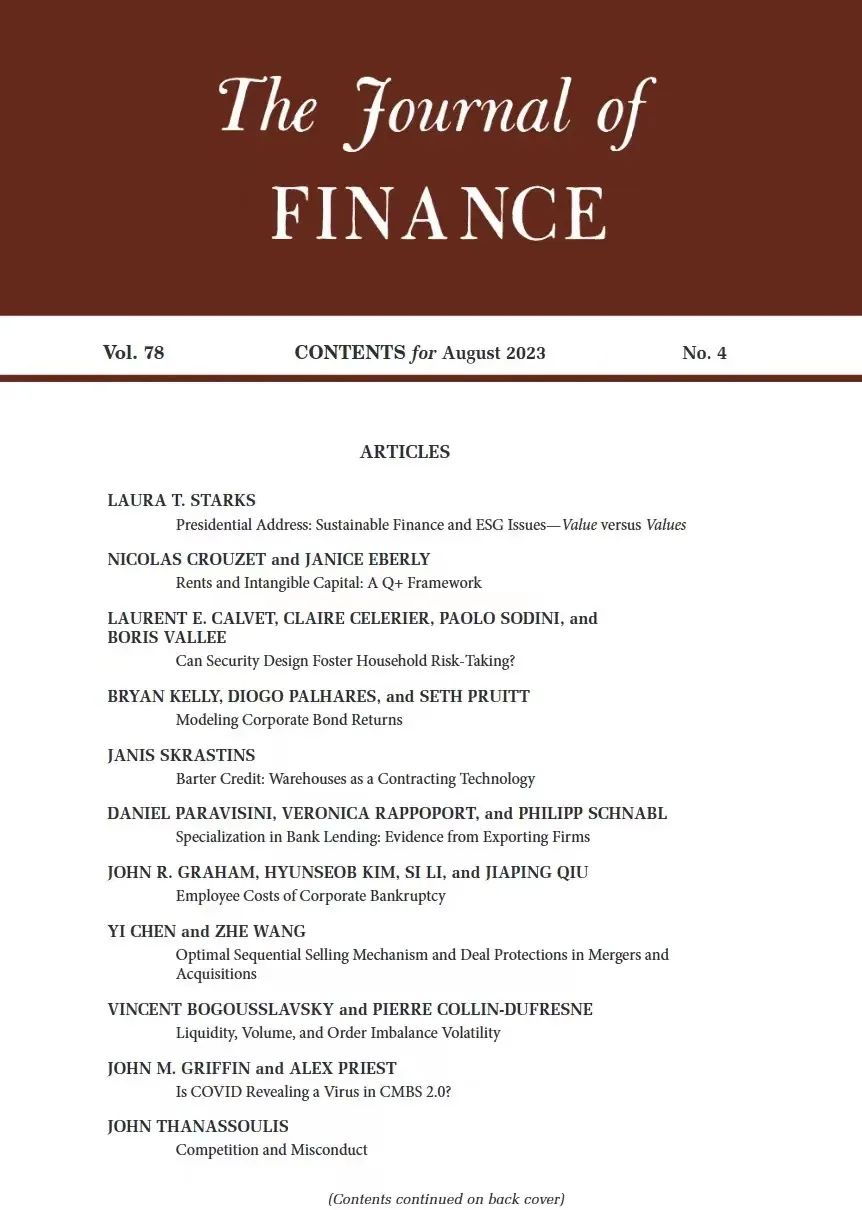
With a strong academic reputation, The Journal of Finance is a top international journal in finance, ranking first among the three top financial journals (JF, JFE, RFS). Its impact factor in 2021 was 7.870.
About the Author
Qiu Jiaping
Tenured Professor of Finance, DeGroote School of Business, McMaster University, Canada
CIBC Chair in Financial Markets
Visiting Professor at SUFE-DAFI
Qiu has published his research findings in top international academic journals in finance and management such as The Journal of Finance, Accounting Review, Journal of Financial and Quantitative Analysis, Review of Finance, Journal of Financial Economics, Review of Financial Studies, and Management Science. He also serves as deputy editor-in-chief of Frontier of Economics in China, Quarterly Review of Economics and Finance and The International journal of Accounting, as well as reviewer for Swiss National Foundation, Hong Kong Research Foundation, and Canadian National Social Sciences and Humanities Foundation.
Abstract
An employee's annual earnings fall by 13% in the first full calendar year after her firm's bankruptcy, and the present value of lost earnings from bankruptcy to six years following bankruptcy is 87% of pre-bankruptcy annual earnings. More worker earnings are lost in thin labor markets and among small firms. Ex ante compensating wage differentials for this “bankruptcy risk” are up to 2% of firm value for a firm whose credit rating falls from AA to BBB, comparable in magnitude to debt tax benefits. Thus, wage premia for expected costs of bankruptcy are sufficiently large to be an important consideration in capital structure decisions.
Graham, JohnR., Kim, Hyunseob, LI, Si, and Qiu, Jiaping, 2023, Employee costs of corporate bankruptcy, The Journal of Finance 00, 00–00. https://doi.org/10.1111/jofi.13251
Viewpoints
Companies at high risk of bankruptcy must pay more to keep employees
When employees worry about losing their jobs if a company goes bankrupt, their demand for wages will rise, which may offset the tax benefits of debt increased by the company.
When a company goes bankrupt, employees will experience both short-term and long-term income losses
We find that an employee’s annual earnings fall by 13% in the first full calendar year after his/her firm’s bankruptcy, and the present value of lost earnings from bankruptcy to six years following bankruptcy is 87% (adjusting for unemployment insurance) of pre-bankruptcy annual earnings. Importantly, earnings losses are larger for workers who leave the industry post-bankruptcy and for workers who worked in thinner local labor markets before bankruptcy.
Companies at a risk of severe distress are transferring a significant portion of the risk to their employees
While some employees are compensated for such risk transfer through a higher wage, it may not be enough for many employees, especially those who cannot easily find a new job.
Our research shows that if tax policies create a disincentive to use debt – for example, policies that ultimately limit debt deductions – employees may have greater job security but also be paid less. On the other hand, tax policies that reward leverage may lead to higher wages for workers in a firm at a risk of bankruptcy, yet at the expense of job security.
Indirect bankruptcy costs are significant enough to be a first-order consideration when firms make capital structure choices
We examine how corporate bankruptcy leads to employee earnings losses due to adjustments in labor markets. We use worker-firm matched data from the U.S. Census Bureau to show that employee earnings deteriorate significantly post-bankruptcy. The present value of earnings losses accumulated over seven years averages 87% of pre-bankruptcy annual earnings. Earnings losses are larger for individuals who leave the industry, who work for smaller firms, or who face thinner local labor markets. These results highlight the role of industry-specific human capital and costs of moving across geographical areas as important forces behind the post-bankruptcy earnings loss.
Given that higher leverage is associated with a greater probability of bankruptcy, our analysis suggests that the greater probability of losing wages ex post in bankruptcy translates into higher ex ante wages (wage premia) demanded by employees of high–leverage companies. We show that the ex ante wage premium that firms must pay to compensate for the expected earnings loss due to bankruptcy is a considerable fraction of the magnitude of the tax benefits of debt. Our results suggest that these indirect bankruptcy costs are significant enough to be a first-order consideration when firms make capital structure choices.
An important direction for future research is to provide direct evidence of the causal impact of wage premia on actual capital structure choices.